New York, Aug 26 : Not only red rocks and craters we were able to see in the cult science film ‘Martian’, starring Matt Damon, Mars has numerous volcanic rocks made of massive grains of Olivine, which is the less muddy version of the peridot which makes beaches in Hawaii dark green NASA’s rover Perseverance has discovered.Perseverance The Perseverance landed in the Jezero Crater, which was selected partly due to its past as a lake, and also as part of an extensive river system in the past, the time when Mars had liquid air, water, and magnetic field.
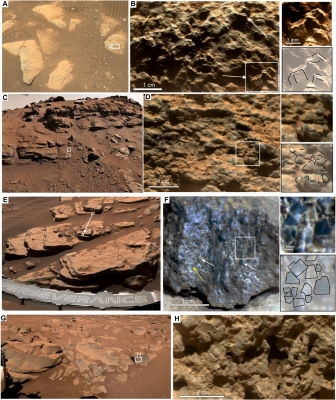
The discovery of the rover upon the ground was shocking.Instead of the usual sedimentary rocks — swept in by rivers , and deposited at the bottom of the lakethe majority of these rocks are darker green in the natural world according to scientists of Purdue University in the US.
“We began to realize that the igneous rocks with layers that we were studying looked very like the igneous rock that we have today on Earth.They’re very similar to the igneous rocks that were found on Earth in the early days in its history,” said planetary scientist Roger Wien in the study published in the journals Science and Science Advances.
Understanding the rocks of Mars their development, evolution and their history, and what they tell us about the past of the planetary environment on Mars can help scientists understand the possibility of life forming on Mars and how it is in comparison with the conditions of early life and on the ancient Earth.
“One of the reasons we aren’t able to get a good understanding of the exact location and time the time when life first began to evolve on Earth is that the stones are in a lot of disrepair, and it’s really difficult to imagine what the ancient conditions that existed on Earth were like.” explained Briony Horgan who is an associate professor in Purdue’s College of Science.
“The rocks Perseverance is scouting in Jezero have mostly been sitting on the surface for billions of years eagerly awaiting our arrival to take a look.
This is one of the reasons why Mars is a key laboratory to understand the solar system’s early days,” he added.
The lava and rocks the rover is looking at on Mars are more than four billion years old.
Older rocks are still in Earth but are extremely battered and weathered, thanks to the active tectonic plates of Earth and the weathering effect of billions of years of water, wind, and life.
On Mars the rocks are crystal clear and more readable to analyze.
Scientists can make use of the conditions of earlier Mars to help determine the conditions and environment on Earth at the same time, when life was just beginning to emerge.
“From orbit we gazed at the rocks and thought”Oh, they’ve got beautiful layers! We believed that they might be sedimentary rocks” Horgan said.
“And it was not until we got close to them and examined them at a millimeter scale that we realized they were not sedimentary rocks” he added.
na/dpb